If you're on facebook, please like it... there will be a giveaway when we reach 50 likes! (Don't ask me what the giveaway will actually be... but it will be good!)
Showing posts with label informative. Show all posts
Saturday, March 24, 2012
Attention Facebook-ers!
Finally the boredness (that's a noun) resulting from not wanting to clean or cook has resulted in me creating a facebook page for A Beautiful Ramble! (Hip Hip Hooray!)
If you're on facebook, please like it... there will be a giveaway when we reach 50 likes! (Don't ask me what the giveaway will actually be... but it will be good!)
Monday, April 4, 2011
Making the Saroyan
(Crocheters, there's a little note at the end especially for you!)
I've had a few people comment on the saroyan I made for my sister, asking if it would be too hard for an inexperienced knitter, or saying that they "could never make that".
In response, I want to encourage all of you who knit, love the scarf, but are hesitant to have a go at it. It was my first lace project. If you can knit and purl, you have the prerequisites to make this scarf. The leaves that edge the scarf are made using combinations of decreases (such as knitting 2 stitches together: k2tog) and increases (like yarn overs [yo] and knitting into the front and the back of the stitch [kfb] which may be difficult if you knit very tightly, but other than that is simple).
If you look at the picture below, you can see that the majority of each row is plain stockingette: knitting and purling. Very easy! The leaf portion of each row is very small.
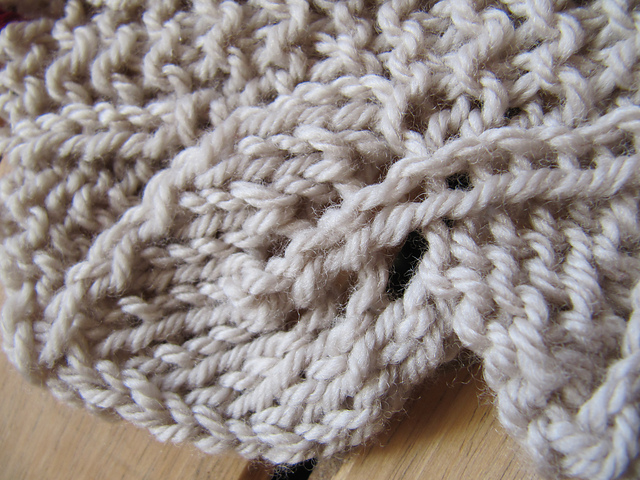
Looking at an individual leaf (see the picture below), you can see that a portion of each leaf contains a significant amount of stockingette stitch, just like the body of the scarf. The holes are made using yarn overs (yo) which really are very easy: simply wrap the yarn anticlockwise from bottom to top around the needle in your right hand (for right handed knitters, of course, the other needle if you're left handed). The leaf also uses one or two other increases, which are all demonstrated here at Knitting Help.
The leaf also utilises decreases to form its shape, these can all be seen here, also at Knitting Help. Knitting Help really does live up to it's name: you will also find videos on how to cast off, which you need to know, as when a leaf is completed, six stitches are cast off, making the leaves stand out more. This is simple, and not something of which to be nervous.
As with many projects, the first bit is the hardest, but by no means is it impossible. If you visit my project page on ravelry for the saroyan, you can see the changes I made. You can also see that it only took me a month to make (as I restarted it on the 23rd of November after deciding that I wanted to begin it differently to how the pattern is written). You will also be able to finish this in a month, just by doing one repeat (that is, a new leaf) every day. If you visit the ravely pattern page for the saroyan, you will get more information, and you will also be able to look at the saroyans made by other people, finding information and tips.
Lastly, let me encourage you by saying this: if you don't try to learn new techniques (such as knitting lace) your knitting skills will stagnate and you will will never know what you are capable of doing and making.
For the crocheters out there who like this design but never want to knit, Camille is a crochet version of the Saroyan, and really is very pretty - I plan to make it one day. I imagine that it would be gorgeous made out of a merino and silk blend: warm yet drapy.
Monday, May 17, 2010
Handmadehobart Market
It is a couple days late, but I think some mental space was needed before I even felt up to posting some pictures of.................
Our stall at the handmadehobart market!
My SIL, a friend and myself all shared a stall. This picture is from the second day when we had improved our look (stay tuned for another post on that), and I think it looks pretty awesome :)
I made these neckwarmers using my Urban Shells Scarf pattern (free!). (My other free crochet patterns can be found here, two of them also have pdf downloads). The shawl pins are made from horn, I think all the ones you can see here are made from ox horn.
My SIL made these adorabe overalls. She is one clever chicky! The best part is..... custom orders! She also made the recycled denim bibs you can see hanging up on the basket and the pink flowery dress lying on the table. If you scroll back up to the first photo you can see some more of what she makes. The few things that did not sell at the market are now in her shop, Wee Threads.
The market goes over two days and happens every two months in Hobart, Tasmania. All the stalls were amazing. I bought a gorgeous scarf from one and did some swaps with a couple other stall holders. I will be back later in the week to show you what I got!
It was a great experience, I loved meeting other stall holders and am hanging out for the next market we do!
Kathy xxx
P.s. I have a few more market-related posts coming up... other stall holders... what I got... my thoughts on markets in Tasmania... what we learnt and what we will change...
Friday, March 26, 2010
I Am Totally Impressed by Utas
There is something at the University of Tasmania that is new, green and tasty. It is not hidden away behind the horticulture building and it does not involve a concrete slab building.
What is it?
Why, it is the new organic food co-operative and community garden!
Source is on university property, right near the hub of uni life (that is, the uni bookshop, bar, newagency and the ref - a cafeteria of sorts). It is a straw bale and timber building (love), has a pizza oven and a rather large community garden. So many pumpkins, tomatos and beans! The cauliflowers are growing well too.
A pretty vegetable picture!
These are actually from Woolworths (a huge supermarket chain).... though the zucchini is from someone's veggie garden, so it might be organic!
Inside the store you can buy organic veggies and fruit (some from that very garden) as well as organic honey and other things you would find in a health food store (agave nectar! I really want to get some).
This centre also has a green recycling system, meaning that the wastes from the ref can are now getting turned into compost. (Though if they used all the waste food that would be a MASSIVE amount of compost... I wonder how much they are actually using?)
If you become a member you get a discount of 20% on everything there, but I'm not sure abouut joining as it seems to have more responsibility associated with it than most other memberships do (such as doing volunteer work sometimes). It is a co-op, after all. Also, the prices are very competitive. I did not see any that made me think, "they're crazy, asking that much!"
It is going to be so much easier for me now if I want to buy something organic, seeing as I am already at the uni a couple days a week. I leave you with the objective of Source:
The provision of low cost, local, organic and minimally packaged food to members in a manner which provides them with a hands-on education in how to live more sustainable in an urban environment.
Sounds good to me!
Kathy xx
Wednesday, March 17, 2010
How Did St. Patrick's Day Come About?
Today is GREEN day! I am wearing black and purple (no, I'm not emo, even though I also have a blog) and no green at all but that is beside the point. I'm not one to celebrate random holidays but I am a Curious Kathy and I like to know the why and how of things. So...
Saint Patricks Day!
When?
17 March, unless the 17th happens to fall within Holy Week (the week leading up to Easter). This happened in 1940, when it was celebrated instead on April 3, in 2008, when it was observed on 15 March. The next time this happens will not be until 2160!
Who?
Well, a guy called Patrick, obviously. It is generally accepted that Pat was born in 387 and died in 493. He is now the patron saint of Ireland, which is amusing as he only went there in the first place because he was captured by Irish raiders and taken to Ireland to be a slave. After escaping, he trained to be a priest, before going back to Ireland as a bishop to convert the Irish to Christianity.
Why the Green?
You might be surprised (like I was) to know that BLUE was the original colour associated with St. Pat. However, now green is the colour associated with him, due to the shamrock.
What is the Deal with the Shamrock?
Ah yes, the shamrock. I always thought it was to do with good fortune or something like that (I should have known better, it is afterall a SAINT day). It turns out that St. Pat used the shamrock, or clover, to explain the Trinity of God (that is, Father, Son and Holy Spirit: three but also one, just like the three leaves make one shamrock) to the pre-Christian Irish. Now, the shamrock is the registered trademark of the Government of Ireland. The phrase "the wearing of the green" means to wear a shamrock.
When did it Become a Public Holiday?
St. Pat's day was officially made a public holiday in 1903. However, it is generally believed that the day has been celebrated since the 1600s. Although in much of the world St. Pat's day is celebrated in a secular fashion, in Ireland it is still a religious day for both the Roman Catholic Church and the Church of Ireland.
So there we are, a blog post written entirely in green, with the exception of other colour words!
All my information was shamelessly taken from Wikipedia... you would be surprised at how stringent the guidelines are for contributing!
Subscribe to:
Posts (Atom)